Why Does My English Sound Flat? Intonation for Adult Learners
Published 11 November 2026
Short answer: English sounds “flat” when the voice stays at nearly the same pitch from start to finish. Questions don’t rise, statements don’t fall at the end, and every word gets about the same weight and time. It usually comes from the melody of your first language, not from poor pronunciation, and it can be practised separately: first the endings, then a wider range, then pauses and speed.
Many adult learners are told their English is “clear but flat”, “a bit monotone” or “hard to follow in long sentences”, even when their grammar and vocabulary are strong. This article explains what listeners are actually hearing, why it matters more than it seems, and a short daily routine that works on the melody without trying to change your accent.
What does “flat” English actually mean?
It means the pitch of the voice moves too little to carry meaning. In English, the rise and fall of the voice tells the listener three things:
- Is this a question or a statement? A yes/no question rises at the end; a statement falls.
- Is the speaker finished? A fall at the end means “done”; a level or rising voice before a pause means “more is coming”.
- What is important? The voice jumps on the words that matter.
When the pitch barely moves, the listener has to work all of this out from the words alone. They usually can — but it costs effort, and the effort shows up as “I had to concentrate to follow you”.
Compare a natural question and a natural statement from a work conversation. Both are real pitch lines from Apple’s American English voice:

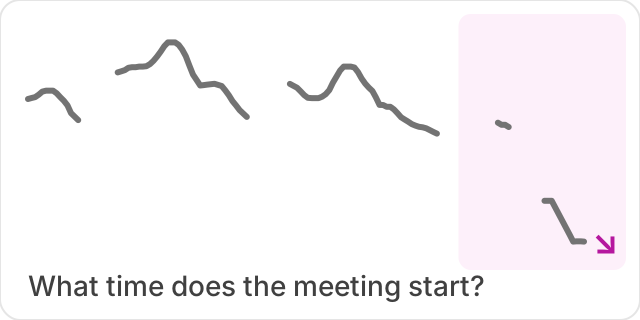
A flat version of either would end at the same height as it started. The words would be identical; the message would be weaker.
Why does my English sound flat?
Because your first language uses pitch differently, and the habit transfers. Some common patterns:
- Cantonese and Mandarin use pitch to tell words apart (the tones), and mark questions with a word such as 嗎 / 吗. Speakers often keep pitch “busy” on each syllable but don’t move it across the whole sentence, so English questions end without a rise.
- Japanese marks questions with か and keeps each word’s own pitch accent. The sentence as a whole stays in a narrow band — what Japanese speakers themselves call 棒読み (reading in a flat line).
- Korean speech often ends questions of every kind with a rise, and its rhythm gives syllables fairly even timing; English can come out with rises on wh-questions and a narrow range elsewhere.
- Spanish and French have more pitch movement, but give syllables more even timing than English, and French questions often rise even with a question word.
None of this is a fault. It’s a skilled speaker using the right melody — for a different language. That is why it doesn’t fix itself through more vocabulary or grammar study.
Does flat intonation really matter at work?
Yes, because listeners judge attitude from melody, often without realising it. A flat voice can be heard as unsure, bored or unfriendly, even when you are none of those things. A few common situations:
- Asking a question that isn’t heard as one. You’ve sent the invoice? said flat sounds like a statement, so the other person may not answer.
- Sounding unfinished or finished at the wrong time. In meetings, a fall too early invites interruptions; no fall at all leaves people waiting.
- Presentations that are hard to follow. Long sentences without clear pauses and endings blur together.
The goal is not a native accent. You can keep your accent completely and still have clear endings and a lively range — and those help listeners follow you whatever your accent.
How can I fix flat intonation? A ten-minute routine
Work on one thing at a time, in this order: endings, range, then pauses and speed. Ten minutes a day is enough.
- Endings (3 minutes). Take five questions and five statements from your own working day. Mark each ↗ or ↘ (yes/no questions up; wh-questions, statements and instructions down). Say each one with an exaggerated ending.
- Range (3 minutes). Say the same sentences again, letting the voice go higher on the important word and lower at the end. Exaggerate. Most learners need more movement than feels comfortable at first.
- Pauses and speed (2 minutes). Read one longer sentence with a pause at each comma and after the opening part (When the call ends, / I’ll send the notes). See Where to Pause When Reading English Aloud for the rules.
- Listen back (2 minutes). Record yourself on your phone and listen only to the endings. Did each one go where your arrow says?
Recording is the step most people skip, and it matters most. We hear our own voice from the inside, so a flat voice often sounds lively to its owner.
What’s the difference between intonation and accent?
Accent is how individual sounds are made; intonation is the melody across the sentence. You can change one without the other.
- Accent: the vowel in bath, whether the r is pronounced, how th is said.
- Intonation: whether Is it ready? goes up, whether Where is it? goes down, how wide the voice moves, where the pauses go.
That distinction matters for practice. Accent training needs careful listening to sounds, often with a teacher. Intonation can be checked by anyone with a recording, because up, down and pauses are easy to hear and even easier to see as a pitch line.
Try it: work sentences, up or down?
- Is this seat taken? ↗
- Where’s the nearest station? ↘
- The meeting has moved to Thursday. ↘
- Have you sent the invoice yet? ↗
- What do you think about the new plan? ↘
- Is the report ready? ↗
- Let me check and get back to you. ↘
- You’ve already finished? ↗ (surprised)
AccentEasy is built for exactly this check. Adults choose Beginner, Intermediate or Advanced; you hear a model sentence, say it, and see your pitch line over the model’s, with a verdict on the ending and a liveliness meter showing whether your range was flat, OK or lively. The voice is analysed on the phone and never saved or sent. For the full rules on questions, see Does a Yes/No Question Go Up or Down?.
Frequently Asked Questions
Why does my English sound monotone?
Usually because the pitch of your voice moves very little across the sentence, so questions don’t rise and statements don’t fall clearly. This is a habit carried over from your first language’s melody, and it can be practised separately from pronunciation and grammar.
Can adults improve their intonation?
Yes. Intonation is a habit of how the voice moves, not a fixed trait, and adults can change it with short, regular practice — especially when they record themselves and listen to the endings. Changing intonation does not require changing your accent.
Is flat intonation rude in English?
It isn’t rude, but it can be misheard. Listeners often read a flat voice as bored, unsure or unfriendly. Clear endings and a bit more range let your words carry the attitude you intend.
Should I copy a native speaker’s intonation exactly?
No. Aim for the patterns — questions up or down at the end, a fall when you finish, pauses between ideas — not for an exact copy of one person’s voice. Exaggerating the patterns in practice helps; in real conversation they settle to a natural size.
How do I know if my intonation has improved?
Record the same five sentences once a week and compare. Listen for clearer endings and a wider range. Seeing the pitch line drawn makes it easier still, because small rises and falls that are hard to hear become easy to see.
AccentEasy turns this into a two-minute habit: listen to the model, say the sentence, and see your voice drawn as a line over the model’s — with a clear answer on whether it went up or down. Download free on the App Store.