Where to Pause When Reading English Aloud: Commas, Thought Groups and Examples
Published 11 November 2026
Short answer: in a longer English sentence, pause briefly where the ideas break — at a comma, after an opening part such as When the rain stopped, or If you finish early,, and before a new part joined by and, but or so. Don’t pause inside a small group of words that belong together, such as the red bus or at nine o’clock. A short sentence needs no pause at all.
These breaks are often called thought groups: each one carries one idea, and the pause tells the listener “that idea is complete, here comes the next”. Getting them right makes long sentences far easier to follow, even when every word is pronounced well. This guide shows what a pause looks like in a real voice, gives five rules, and ends with marked sentences to practise.
What does a pause look like in real speech?
A pause is a short silence, and the voice usually sets it up by staying level before it — not by falling. Here is the real pitch line of Apple’s American English voice (AccentEasy’s model voice) reading a sentence with a comma:
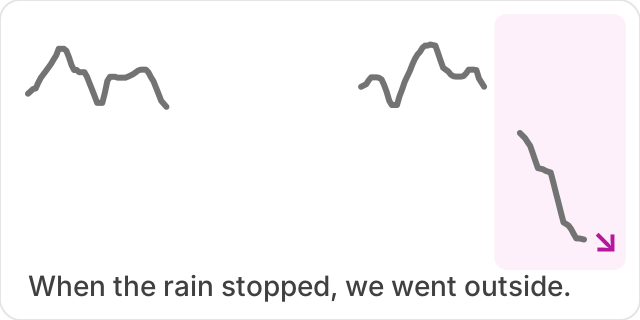
Two things to notice:
- The first part doesn’t fall. It ends in the middle of the voice, which tells the listener the sentence isn’t finished. (Speakers don’t always do this — a small fall before a comma is common too — but keeping the voice up is the clearest way to join the two parts.)
- The big fall comes only at the very end. Learners who fall at every comma sound as if they are reading a list of separate sentences.
Try this now: read When the rain stopped, we went outside twice — once with a fall before the comma, once keeping the voice up. The second version sounds like one sentence.
Where should you pause? Five rules
Pause where you could add “and then…” in your head, and nowhere else. In practice that comes down to five rules.
- At a comma. After the match, / we had pizza. A comma is almost always a pause point when reading aloud.
- After an opening clause — a part that starts with when, if, because, after, before, although. Because it was cold, / we stayed in. There is usually a comma there, but not always; pause anyway.
- Before a new clause joined by and, but, so when both parts are long. The bus was late, / so we walked. With short parts (I came and sat down) there’s no need.
- After a long subject. The girl who sits next to me in maths / is moving to Leeds. The pause comes before the verb, not in the middle of the subject.
- At a full stop — a little longer. Full stops and question marks get a longer pause than commas, so the listener hears where each sentence ends.
Where you should not pause: between the and its noun (the / library), between a verb and a short object (opened / the door), or in the middle of a time or place (at half / past six). These break a thought group in two, and the listener loses the meaning.
Do short sentences need a pause?
No — a short sentence should come out in one smooth piece, with no stop in the middle. Turn left at the bakery. I’d like a table for two, please. Stopping halfway through a short sentence is one of the most common habits of careful readers: each word is said correctly, but the sentence sounds like a list of words.
The fix is to read the sentence silently first, then say it in one breath. If you run out of breath in a sentence of six or seven words, you are probably speaking too slowly rather than needing a pause.
How fast should you read?
At a natural speed: not so fast that words run together, not so slow that the sentence breaks apart. Speed and pausing are linked — readers who go very slowly tend to add pauses everywhere, and readers who rush tend to drop the pauses that are needed.
A simple check: read the sentence, then say it again as if telling a friend. If the two versions sound very different in speed, aim for something between them. Reading aloud should sound like speaking, just a little clearer.
For parents: you don’t need to judge the English to judge the speed. Listen to whether your child stops in the middle of short sentences, and whether long sentences have a breath at the commas. Both are easy to hear.
Why do learners pause in the wrong places?
Most “wrong” pauses come from reading word by word, or from the rhythm of the first language.
- Word-by-word reading. When a reader is still decoding each word, every word gets its own small pause. This fades as reading becomes more fluent, which is why rereading the same sentence two or three times helps.
- Pausing to breathe. Readers who don’t plan the breath stop wherever the air runs out. Marking the pause points before reading solves this.
- First-language rhythm. Languages such as Cantonese, Mandarin, Japanese, Korean, Spanish and French give syllables a more even timing than English does. Readers carry that evenness over, so English comes out at one speed, with breaks that don’t match the ideas. Adults who hear their English described as “flat” are usually hearing this together with narrow pitch: see Why Does My English Sound Flat?.
Daily, short practice helps more than long sessions. If you want a routine for reading aloud at home, ReadAloudEasy’s guide on building a daily reading-aloud habit fits well alongside the pause marks below.
How do you mark pauses before reading aloud?
Use a pencil and a slash. Before reading a passage aloud:
- Read it silently once for meaning.
- Put a slash ( / ) at each pause point using the five rules: commas, after opening clauses, before long joined clauses, after long subjects.
- Put a double slash ( // ) at each full stop.
- Read it aloud, pausing only at the slashes, and keeping the voice up before a single slash.
- Read it again without looking at the slashes. The pauses should now come naturally.
The marking works with any text — a school reader, a news article, a work presentation.
Try it: marked sentences
Say each one, pausing only at the slash.
- If it rains tomorrow, / we’ll stay at home.
- On Saturday morning, / I tidied my room.
- When the phone rang, / I was in the garden.
- If you finish early, / read your book quietly.
- The bus was late, / so we walked.
- Bring your swimming kit on Friday. (no pause)
If you’d like a second pair of ears, AccentEasy’s Rhythm & Tempo practice shows the sentence with its pause points marked, then lays out your take on a timeline so you can see where you paused, along with whether your speed was a bit fast, just right or a bit slow.
The other half of reading aloud well is the melody at the end of each sentence: see Does a Yes/No Question Go Up or Down?.
Frequently Asked Questions
Should you always pause at a comma when reading aloud?
Almost always. A short pause at a comma helps the listener hear where one idea ends and the next begins. In a very short phrase such as “Yes, please” the pause can be tiny, but it is still there.
How long should a pause be?
Brief — a short breath, not a full stop. Pauses at commas are shorter than pauses at full stops. A pause that is too long makes the sentence fall apart, so practise keeping it short and keeping the voice up before it.
What is a thought group in English?
A thought group is a group of words that carries one idea and is said together, such as “when the rain stopped” or “at nine o’clock”. Speakers pause between thought groups, not inside them, which helps listeners follow long sentences.
Does the voice go down before a pause?
Usually not before a comma. In the middle of a sentence the voice tends to stay level or rise slightly before a pause, which signals that more is coming. The clear fall comes at the end of the sentence.
Why does my reading sound choppy?
Choppy reading usually means pausing too often — after every word or two — or pausing in the middle of thought groups. Read the sentence silently first, mark the pause points, then read it in as few pieces as the meaning allows.
AccentEasy turns this into a two-minute habit: listen to the model, say the sentence, and see where you paused and whether your speed was natural. Download free on the App Store.